" height="18.205000133514407px" id="Q9ldQFEPI" width="99.29999682617188px"/></svg>)
Blogs
Your First Step Into Voice AI: A Practical Guide for Businesses in Africa & the Middle East
Your First Step Into Voice AI: A Practical Guide for Businesses in Africa & the Middle East
Published
•
Written by
Mariama Diallo
3 min Read
Keep Reading

Your First Step Into Voice AI: A Practical Guide for Businesses in Africa & the Middle East
4 min read
The voice revolution is not coming. It is already here. And for businesses in Africa and the Middle East, the timing has never been better to get in on the ground floor.
Across both regions, mobile penetration is soaring, multilingual populations are the norm, and millions of people who have limited access to screens or keyboards are already picking up their phones and speaking. Voice AI is not just a convenience for these markets. It is a bridge.
Why Africa and the Middle East Are Primed for Voice AI
Consider the numbers. Africa has over 1.4 billion people and mobile internet usage is growing faster than anywhere else in the world. In the Middle East, smartphone adoption is among the highest globally, and Arabic is one of the most spoken languages on earth. Yet voice-enabled products built for these markets remain surprisingly scarce.
This is a gap, and gaps are opportunities. Businesses that move early will define what voice AI looks like in their industry and their region. Those that wait will be playing catch-up to competitors who already own the customer relationship.
What Does ‘Getting Started’ Actually Look Like?
The most common mistake businesses make when exploring Voice AI is trying to do too much at once. They imagine overhauling their entire customer service operation overnight. The smarter approach is to start with one use case and prove the value.
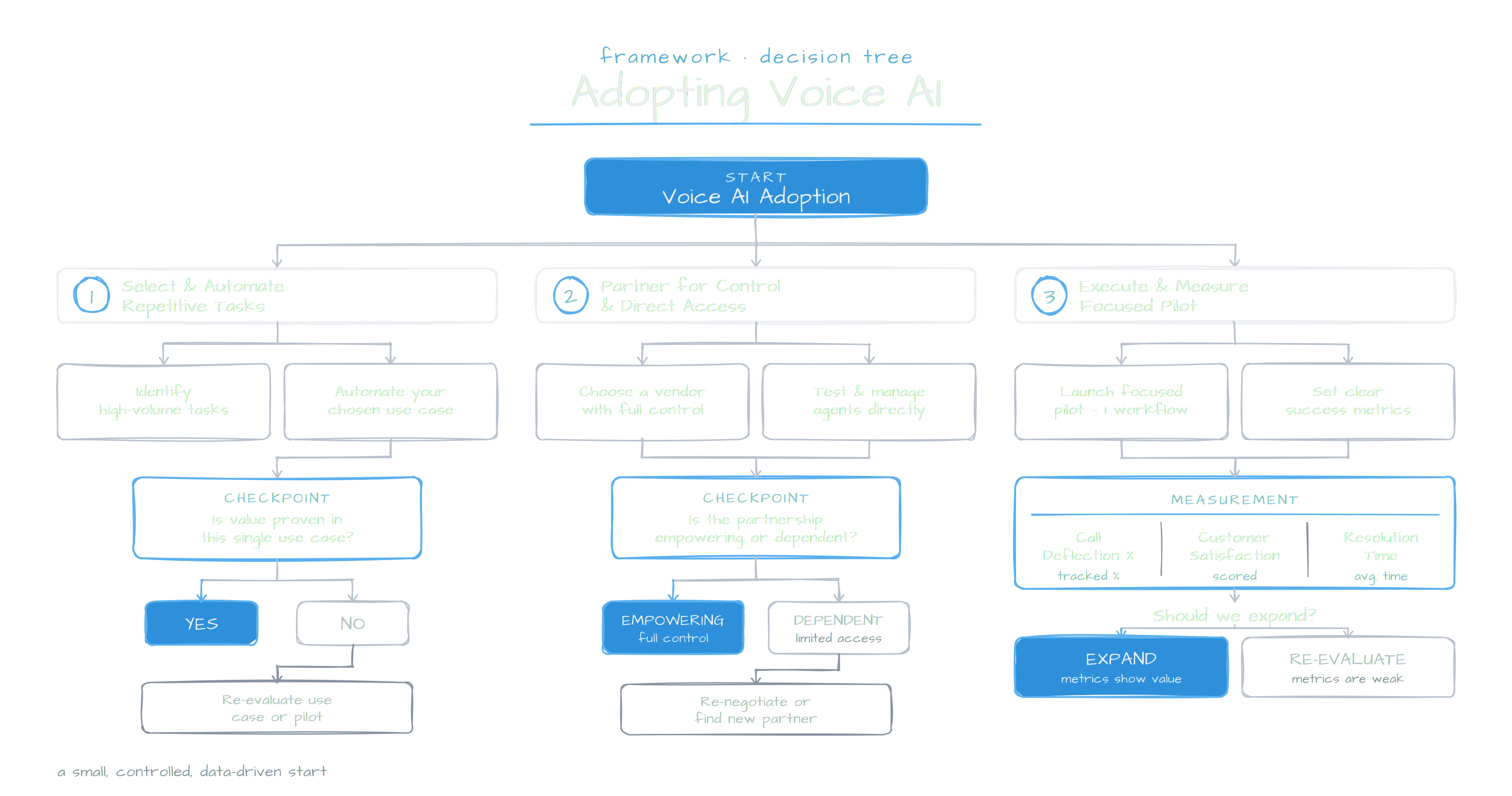
Here is a simple three-step framework for your first move into voice:
Start with one use case. Pick your highest-volume, most repetitive customer interaction and automate that first. Prove the value in one place before expanding anywhere else.
Choose your partner wisely. This matters more than most companies realize. If you cannot build, test, and manage your own voice agents without the vendor doing it for you, that is a problem. You should have direct access to your own deployment. A partner that keeps you dependent on them for every change is not building your capability, they are building their own leverage over you.
Start small and stay in control. Resist the pressure to overhaul everything at once. A focused pilot on one workflow, with clear success metrics and a team that owns the outcome, will teach you more in four weeks than a sprawling deployment will in six months.
Measure what matters. Track call deflection rate (how many interactions were resolved without a human agent), customer satisfaction scores, and resolution time. These numbers tell you whether to expand. If the numbers are not there, a good partner will help you understand why.
Common Concerns, Addressed
“Our customers won’t trust a machine.”
This is real, and it matters. Transparency is the answer: let customers know they are speaking with a voice AI and give them a simple way to reach a human. Trust is built over repeated positive experiences, not promised upfront.
“We don’t have the technical team for this.”
You don’t need one. Modern voice AI platforms are built to be deployed with minimal engineering. Partnering with the right vendor means the technical complexity stays on their side. Aethex AI, for instance, is purpose-built for fast deployment in markets like these, handling the integration work so your team can focus on outcomes.
The Competitive Window Is Open (For Now)
The businesses that will lead in customer experience five years from now are making their first voice AI investments today. The barrier to entry is lower than it has ever been, and the markets in Africa and the Middle East are at an inflection point.
Your first step does not need to be your biggest one. It just needs to happen. Ready to get started? Talk to a live agent now via the Voice Chat widget at aethexai.com and book a demo.
Your First Step Into Voice AI: A Practical Guide for Businesses in Africa & the Middle East
4 min read
The voice revolution is not coming. It is already here. And for businesses in Africa and the Middle East, the timing has never been better to get in on the ground floor.
Across both regions, mobile penetration is soaring, multilingual populations are the norm, and millions of people who have limited access to screens or keyboards are already picking up their phones and speaking. Voice AI is not just a convenience for these markets. It is a bridge.
Why Africa and the Middle East Are Primed for Voice AI
Consider the numbers. Africa has over 1.4 billion people and mobile internet usage is growing faster than anywhere else in the world. In the Middle East, smartphone adoption is among the highest globally, and Arabic is one of the most spoken languages on earth. Yet voice-enabled products built for these markets remain surprisingly scarce.
This is a gap, and gaps are opportunities. Businesses that move early will define what voice AI looks like in their industry and their region. Those that wait will be playing catch-up to competitors who already own the customer relationship.
What Does ‘Getting Started’ Actually Look Like?
The most common mistake businesses make when exploring Voice AI is trying to do too much at once. They imagine overhauling their entire customer service operation overnight. The smarter approach is to start with one use case and prove the value.
Here is a simple three-step framework for your first move into voice:
Start with one use case. Pick your highest-volume, most repetitive customer interaction and automate that first. Prove the value in one place before expanding anywhere else.
Choose your partner wisely. This matters more than most companies realize. If you cannot build, test, and manage your own voice agents without the vendor doing it for you, that is a problem. You should have direct access to your own deployment. A partner that keeps you dependent on them for every change is not building your capability, they are building their own leverage over you.
Start small and stay in control. Resist the pressure to overhaul everything at once. A focused pilot on one workflow, with clear success metrics and a team that owns the outcome, will teach you more in four weeks than a sprawling deployment will in six months.
Measure what matters. Track call deflection rate (how many interactions were resolved without a human agent), customer satisfaction scores, and resolution time. These numbers tell you whether to expand. If the numbers are not there, a good partner will help you understand why.
Common Concerns, Addressed
“Our customers won’t trust a machine.”
This is real, and it matters. Transparency is the answer: let customers know they are speaking with a voice AI and give them a simple way to reach a human. Trust is built over repeated positive experiences, not promised upfront.
“We don’t have the technical team for this.”
You don’t need one. Modern voice AI platforms are built to be deployed with minimal engineering. Partnering with the right vendor means the technical complexity stays on their side. Aethex AI, for instance, is purpose-built for fast deployment in markets like these, handling the integration work so your team can focus on outcomes.
The Competitive Window Is Open (For Now)
The businesses that will lead in customer experience five years from now are making their first voice AI investments today. The barrier to entry is lower than it has ever been, and the markets in Africa and the Middle East are at an inflection point.
Your first step does not need to be your biggest one. It just needs to happen. Ready to get started? Talk to a live agent now via the Voice Chat widget at aethexai.com and book a demo.
Your First Step Into Voice AI: A Practical Guide for Businesses in Africa & the Middle East
4 min read
The voice revolution is not coming. It is already here. And for businesses in Africa and the Middle East, the timing has never been better to get in on the ground floor.
Across both regions, mobile penetration is soaring, multilingual populations are the norm, and millions of people who have limited access to screens or keyboards are already picking up their phones and speaking. Voice AI is not just a convenience for these markets. It is a bridge.
Why Africa and the Middle East Are Primed for Voice AI
Consider the numbers. Africa has over 1.4 billion people and mobile internet usage is growing faster than anywhere else in the world. In the Middle East, smartphone adoption is among the highest globally, and Arabic is one of the most spoken languages on earth. Yet voice-enabled products built for these markets remain surprisingly scarce.
This is a gap, and gaps are opportunities. Businesses that move early will define what voice AI looks like in their industry and their region. Those that wait will be playing catch-up to competitors who already own the customer relationship.
What Does ‘Getting Started’ Actually Look Like?
The most common mistake businesses make when exploring Voice AI is trying to do too much at once. They imagine overhauling their entire customer service operation overnight. The smarter approach is to start with one use case and prove the value.
Here is a simple three-step framework for your first move into voice:
Start with one use case. Pick your highest-volume, most repetitive customer interaction and automate that first. Prove the value in one place before expanding anywhere else.
Choose your partner wisely. This matters more than most companies realize. If you cannot build, test, and manage your own voice agents without the vendor doing it for you, that is a problem. You should have direct access to your own deployment. A partner that keeps you dependent on them for every change is not building your capability, they are building their own leverage over you.
Start small and stay in control. Resist the pressure to overhaul everything at once. A focused pilot on one workflow, with clear success metrics and a team that owns the outcome, will teach you more in four weeks than a sprawling deployment will in six months.
Measure what matters. Track call deflection rate (how many interactions were resolved without a human agent), customer satisfaction scores, and resolution time. These numbers tell you whether to expand. If the numbers are not there, a good partner will help you understand why.
Common Concerns, Addressed
“Our customers won’t trust a machine.”
This is real, and it matters. Transparency is the answer: let customers know they are speaking with a voice AI and give them a simple way to reach a human. Trust is built over repeated positive experiences, not promised upfront.
“We don’t have the technical team for this.”
You don’t need one. Modern voice AI platforms are built to be deployed with minimal engineering. Partnering with the right vendor means the technical complexity stays on their side. Aethex AI, for instance, is purpose-built for fast deployment in markets like these, handling the integration work so your team can focus on outcomes.
The Competitive Window Is Open (For Now)
The businesses that will lead in customer experience five years from now are making their first voice AI investments today. The barrier to entry is lower than it has ever been, and the markets in Africa and the Middle East are at an inflection point.
Your first step does not need to be your biggest one. It just needs to happen. Ready to get started? Talk to a live agent now via the Voice Chat widget at aethexai.com and book a demo.
Related Articles
Related Articles



" height="48px" id="GUWw61FwZ" width="48px"/></g></svg>)
" height="39.77194px" id="u4BE2MQos" transform="translate(2 3.808)" width="44px"/></svg>)
" height="47.200121890287576px" id="H2XXrumOQ" width="48.000007146720094px"/></g></svg>)
" height="36.58656032986642px" id="JYRMZCWYV" transform="translate(0 5.278)" width="47.99999468333146px"/></svg>)
The voice AI stack for emerging markets.
See agents in production, configured for your use case, your market, your systems.